
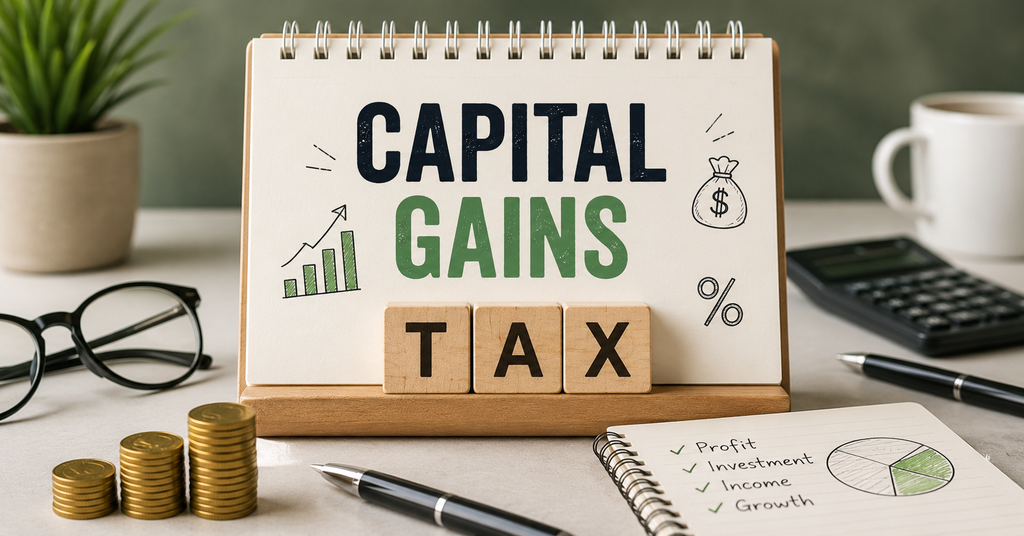
Short Term vs Long Term Capital Gains Tax Differences Every Investor Must Know
The differences between short vs long term capital gains taxes could help you save thousands of dollars and totally change your investment approach. If you are planning your deals using the online capital gains tax calculator or looking for current capital gains tax rates and trying to make a deduction from your capital loss, it is really important to be familiar with these regulations.
If you sell any kind of your property, such as shares, real estate, bonds, or even cryptocurrency, and earn some money, the government will take a portion of your profit as taxes. But the main factor that defines how much you should pay is the time during which you owned the property.
1. What is the Holding Period Distinction?
Key to understanding short-term versus long-term capital gains is the clear cut-off date at one year:
- Short-Term Capital Gains: Occur when you purchase an asset and then dispose of it within a period of one year or less from the purchase date.
- Long-Term Capital Gains: Are applied to assets that have been owned for more than one year before disposal.
This simple time difference changes how tax authorities categorize your profit, subjecting it to entirely different tax brackets and calculations.
2. Short-Term Capital Gains: Taxed as Ordinary Income
If you flip stocks quickly, day-trade crypto, or sell a real estate property within months of purchase, any profit you make is considered a short-term gain.
- How They Are Taxed: Short-term gains are taxed at ordinary income tax rates. This means your profits are added directly on top of your salary, wages, and other earned income.
- The Financial Impact: Depending on your income level, your marginal tax bracket can range anywhere from 10% up to 37%. Because ordinary income tax rates are significantly higher than preferential investment rates, short-term trading can result in a massive tax liability that eats directly into your net compound returns.
3. Long-Term Capital Gains: Rewarding Patient Investors
Governments encourage investments to generate wealth in the long run through the provision of heavily discounted tax rates for investors who retain their investments in the long run.
- Taxing of Long-Term Gains: The preferential tax rates applicable for long-term gains comprise of zero percent (0%), fifteen percent (15%), and twenty percent (20%), depending purely on income and filing status. For example, a person whose taxable income is under $49,450 and married couples filing jointly whose total income is under $98,900 will pay zero percent tax on their long-term gains. It is always better for wealthy people to be taxed either fifteen or twenty percent instead of being taxed heavily on ordinary income.
- Additional Taxes: In addition, individuals whose income exceeds the stipulated amount ($200,000 for individuals and $250,000 for married couples filing jointly) must consider the 3.8% net investment income tax.
4. The Significance of Asset Location and Tax-Sheltered Accounts
Not only does it involve knowing your holding periods, but the place where you have your assets is a huge factor in keeping your total tax liability low. Investing in tax-sheltered accounts like Traditional IRA, Roth IRA, and 401(k) can totally exempt your capital gains from being taxed each year.
In a Roth investment, your capital will grow without paying any taxes on it, since it is exempt from capital gain treatment. Meanwhile, traditional retirement accounts allow your capital gains to compound on a tax-deferred basis until you begin taking distributions in retirement. Balancing your taxable brokerage accounts with tax-advantaged retirement vehicles ensures you maintain ultimate flexibility while keeping your cumulative tax liability to an absolute minimum.
5. Leveraging Capital Losses to Lower Your Tax Bill
Successful investing requires not only dealing with profitable trades but also being able to deal with market downturns and losses effectively. If you dispose of an investment for an amount that is less than what you paid for it, you will have a capital loss.
- Tax-Loss Harvesting: The capital losses can be used against your capital gains on a one-to-one basis. In case you have capital losses exceeding capital gains during a particular tax year, you may deduct up to $3,000 of your excess capital losses against your ordinary income.
- Carryovers: All of your excess net losses in excess of the annual limit of $3,000 may be carried forward infinitely into the future.
How can I estimate what I will owe before filing?
Using a digital capital gains tax calculator can give you a quick estimate. However, always input your expected annual salary alongside your realized short-term and long-term profits to account for how marginal tax brackets overlap.
Conclusion
Time is among the strongest weapons that an investor can have, not only to make money through compounding interest but also through tax deductions. By cutting down on short-term trades and making high-quality investments above one year, you will be in a great position to save yourself from taxes. Make sure that you have a well thought out plan for exiting.